Speech Processing and Brain Asymmetries
Jesse’s foremost research area is the neuroscience of speech processing and brain asymmetries.
Speech processing is the remarkable ability to turn the noises that come from others’ mouths into the meaningful sounds that most of us use to communicate and connect with each other.
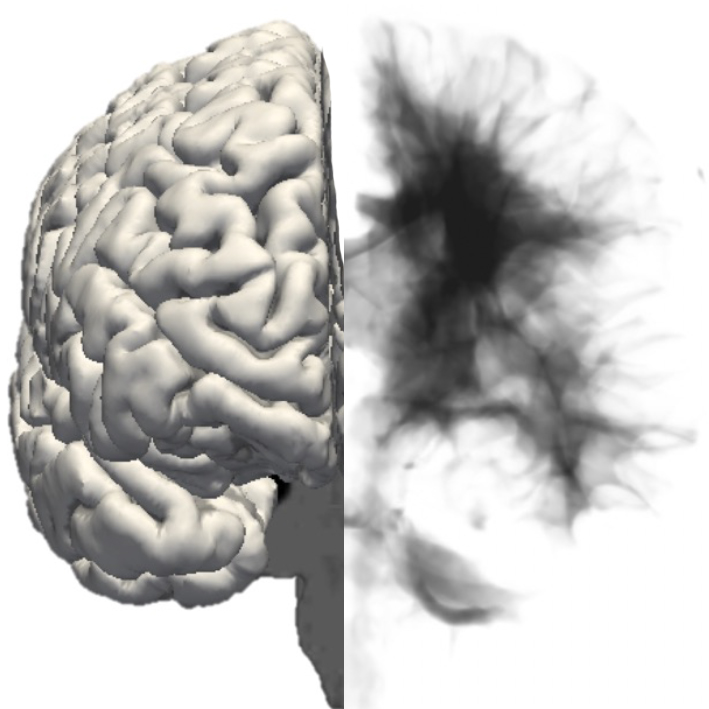
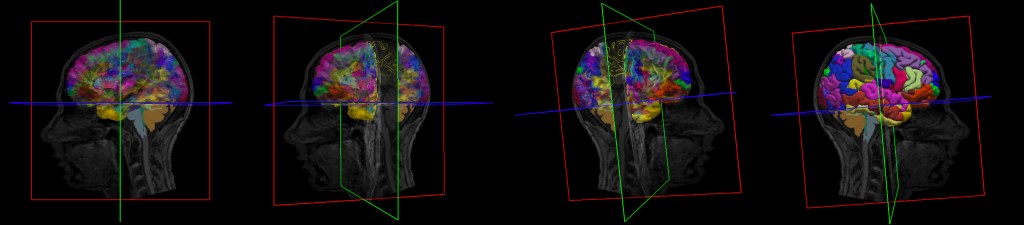
Jesse’s research uses MRI (magnetic resonance imaging) to look at how physical features of brains (e.g., shapes and sizes of brain parts and their connections) relate to people’s abilities, differences, and difficulties of speech processing.
He is especially interested in brain asymmetries: differences of physical features of the left and right halves (hemispheres) of the brain. Speech has long been considered a “left-brain” function. His research is focussed to better understanding (and clearing up misunderstandings of) the different roles that our two hemispheres might have in speech.
Predictive Processing
Jesse studies speech processing under predictive processing: the perspective that brains operate by predicting the sensory information (sights, sounds, sensations etc.) that they will receive from their surrounding environment. For example, if we hear someone sing “Twinkle twinkle, little car” – we will be surprised (having predicted “star” to be the next word). There are “brainwaves” that can indicate the “surprise” of our brain. They can even be used to measure when a brain has registered surprise at some unexpected part of a sound that the person is not even aware of hearing.
“Brainwaves” are waves of electrical activity, captured using EEG (electro-encephalo-graphy): ‘Encephalo’ basically means brain, ‘graphy’ means measuring/writing (like on a graph). So, quite literally, measuring electrical activity of the brain. In Jesse’s research, this activity is in response to speech sounds that are predictable or unpredictable for that brain at that particular moment.
Active Inference
An exciting development has come from neuroscience and physics recently: ‘the free energy principle’, which put (perhaps too) simply is a means of mathematically describing the existence of any and every-thing.
The free energy principle requires some understanding of physics or probability theory and tends to be confusing even for researchers (including neuroscientists). What is more relevant and accessible is active inference, which is an application of the free energy principle to sentient things. It is especially applied to brains, minds, and their behaviour.
In the active inference framework, not only do our brains predict what sensory information they’ll receive from the world, but can also take action to fulfil those predictions.
After all, if we hear someone sing “Twinkle twinkle, little car”, we would probably ask “Are you sure you got that right?”. Our action of asking being a way of making sure our prediction of hearing “star” is more likely in the future.
In some research uses, active inference is simply an extension of predictive processing, but it also has much broader implications. Not only can active inference be used to describe speech processing, but also that we’ve evolved to have ears to hear things in the first place, and in fact evolution itself. A further (yet simplified) description is available here.
Jesse believes that active inference offers a revolution to how mental health can be understood and worked with. He is currently committed to active inference being better understood and utilised in psychology, especially clinical psychological theory and practice.
Publications
Bourke, J. D, Cooper, G., Forstmann, B. I., & Todd, J. (2023). Morphometrical Asymmetries and Tractography of Speech-Relevant Cortex in Relation to Language Lateralisation and Rapid Temporal Processing. Manuscript in Development.
Bourke, J. D. (2023). Active Inference Under the Free Energy Principle: A Model Paradigm for Clinical Psychology as a Scientist-Practitioner Discipline. Manuscript in Development.
Bourke, J. D., & Todd, J. (2021). Acoustics versus linguistics? Context is Part and Parcel to lateralized processing of the parts and parcels of speech. Laterality, 1-41. doi:10.1080/1357650X.2021.1898415
Bourke, J. D. (2019). Hemispheric Asymmetry and Functional Lateralisation in Speech-Related Processes: Behavioural, Psychophysiological, and Structural Factors. Thesis available at https://nova.newcastle.edu.au
Bourke, J. D., Plant, C., & Wooldridge, S. (2018). Interpersonal psychotherapy with expressive art for depression in a psycho-oncology context. Clinical Case Studies, 17(6), 453–468.
Bosshard, S. S., Bourke, J. D., Kunaharan, S., Koller, M., Walla, P., & Heinonen, J. (2016). Established liked versus disliked brands: Brain activity, implicit associations and explicit responses. Cogent Psychology, 3(1). doi:10.1080/23311908.2016.1176691
Gilligan, C., Kypri, K., & Bourke, J. D. (2014). Social networking versus facebook advertising to recruit survey respondents: A Quasi-experimental study. JMIR Research Protocols, 3(3).
Gilligan, C., Thompson, K., Bourke, J. D., Kypri, K., & Stockwell, T. (2014). “Everybody else is doing it”-norm perceptions among parents of adolescents. Journal of Studies on Alcohol and Drugs, 75, 908-918.
Bourke, J. D. (2013). I Think Therefore I Like? Reassessing Implicit and Explicit Brand Attitudes and how they are Conditioned. University of Newcastle Unpublished Manuscript.
Seminar, Training, & Conference Presentations
Bourke, J. D., (2024). Applications of Active Inference to Formulation and Reflective Practice [in Clinical Psychology]. Australian Psychological Society, College of Clinical Psychologists. Webinar.
Bourke, J. D., (2022). Role Models, Internal Working Models, and Generative Models: (Inter)Active Inference as a Dynamical Systems and Psychobiological Lens of Attachment Trauma and Treatment. Invited presentation for Australian & New Zealand Association of Psychotherapy (ANZAP) 31st Annual Conference. Sydney, Australia
Bourke, J. D., (2021). Understanding and Supporting Trauma. In-service training for Toronto Private Hospital mental health staff.
Bourke, J. D., (2019). Listening To, Between, and From Within the Lines we Speak: Brain Asymmetries Underliying Linear and Non-Linear Speech in Therapy. Australian & New Zealand Association of Psychotherapy (ANZAP) 30th Annual Conference. Sydney, Australia.
Bourke, J. D., (2018). The Brain Doing, Being, & Playing in Therapy: A Neuropsychoanalytic Approach to Winnicott. Invited talk for the Eastlakes Mental Health Network Professionals Group.
Bourke, J. D., (2018). On the Value of Play in Therapy for Adults: Perspectives from Neuroscience, Buddhist Psychology, and Winnicottian Psychoanalysis. Invited talk for the Australian Psychological Soceity Psychoanalytic Group Annual Meeting.
Bourke, J. D., Cooper, G., Forstmann B. U., Michie, P., Todd, J., Schall, U. (2018). Rapid Temporal Processing: How Behavioural and Psychophysiological Measures Relate with Asymmetrical Neuroanatomy. Poster presented at Society for Psychophysiological Research (SPR) 58th Annual Meeting: Quebec, Canada.
Bourke, J. D., Todd, J., Schall, U., Cooper, G., Michie, P., Forstmann B. U., Rasser P. (2017). Simple Speech Asymmetries? Not Even: Leftward Lateralisation in Psycholinguistics, Psychoacoustics, and Neuroanatomy.Poster presented at Australasian Neuroscience Society (ANS) 37th Annual Meeting: Sydney, Australia.
Bourke, J. D., Todd, J., Schall, U., Michie, P. (2016). Asymmetries and Rapid Temporal Processing Ability: How do Behaviour, Psychophysiology, and Neuroanatomy Relate? Talk presented at Australaian Cognitive Neuroscience Society (ACNS) 7th Annual Meeting: Newcastle, Australia.
Bourke, J. D., Todd, J., Schall, U. (2015). Determinants of Rapid Temporal Processing Ability: Behaviour, Psychophysiology, and Neuroanatomy. Talk presented at Australasian Society for Psychophysiology (ASP) 25thAnnual Meeting: Sydney, Australia.
Bourke, J. D., Todd, J., Schall, U. (2015). Behaviour, Psychophysiology, and Neuroanatomy in Rapid Temporal Processing Ability. Talk presented at Centre for Brain and Mental Health Research (CBMHR) Post-graduate & Post-doctoral Conference: Newcastle, Australia.

