
What is a clinical psychologist?
What types of psychologists are there?
Training requirements of a clinical psychologist
Other psychological (mental-health) professionals
How do clinical psychologists differ from other mental health practitioners?
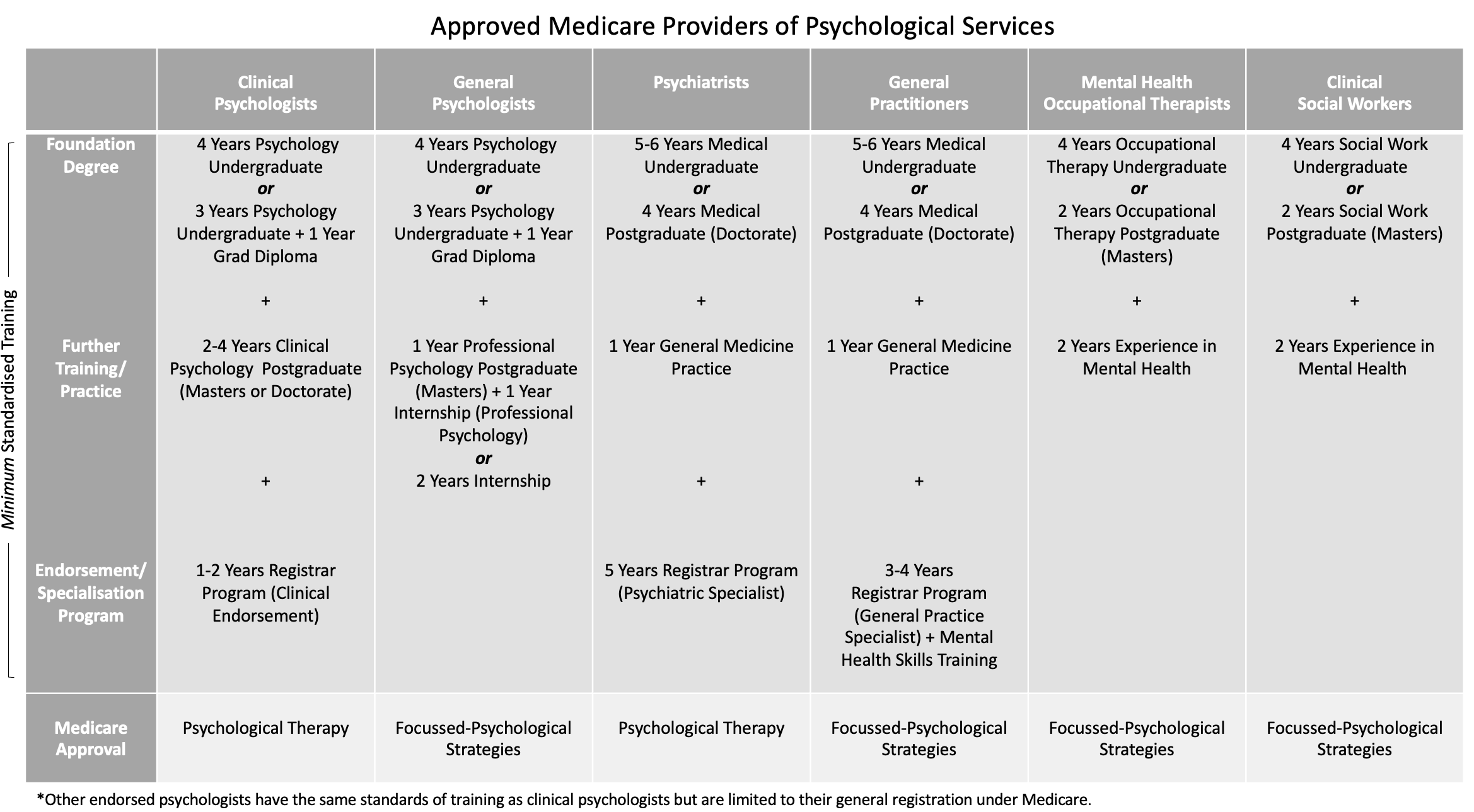
Approved Medicare providers of psychological services
What is a clinical psychologist?
Psychology roughly translates to “study of the mind”; psych meaning mind (or mental) and –ology meaning study. A clinical psychologist then is someone who applies scientific knowledge to assess and treat clinical problems of the mind and behaviour of people (i.e., mental health problems). Training standards for clinical psychologists vary across countries. In Australia it is a minimum 8 years of fundamental training to be fully qualified as a clinical psychologist, involving completion of an accredited psychology undergraduate degree, then masters or doctoral program, followed by a registrar program.
As described below, clinical psychology is actually 1 of 9 different areas of professional practice of psychology in Australia – a psychologist must be endorsed to practice these under the associated title.
What types of psychologists are there?
Endorsed psychologists
In Australia, psychologist is a protected title, which means that it is illegal to use unless registered with the Australian Health Practitioner Regulation Agency (AHPRA; which requires completion of accredited training). All psychologists must have general registration with AHPRA. Psychologist is a generic term for any appropriately qualified and registered professional working in a practice role that applies psychological knowledge.
In Australia there are 9 areas of endorsed practice with the same general training standards but content and supervision specified to their area of expertise:
Clinical Psychology
Organisational Psychology
Counselling Psychology
Clinical Neuropsychology
Educational & Developmental Psychology
Community Psychology
Health Psychology
Forensic Psychology
Sport & Exercise Psychology
An area of endorsement title specifies the extended formal training and expertise of a particular psychologist. This distinction can be important, for example, a clinical psychologist cannot adequately perform the role of a forensic psychologist and vice versa. Either could technically undergo professional development and supervision to attempt to fill their knowledge and competency gap. However, a clinical psychologist working in a forensic role cannot legally call themselves a forensic psychologist without the accredited training and endorsement. Some psychologists do indeed have two (or more) areas of endorsement. This formal qualification and endorsed registration ensures that a psychologist working in an area meets a nationally regulated minimum standard of expertise and competency.
General psychologists
Although all psychologists have general registration, a general psychologist usually refers to a registered psychologist without an area of endorsement. Psychologists without an area of endorsement commonly work in clinical, counselling, educational-developmental (particularly schools), and organisational roles. These professionals have completed a 4 year psychology undergraduate program, followed by either a 2 year internship of professional practice or 1 year professional masters degree and 1 year internship.
Provisional Psychologists
Provisional psychologists are psychologists-in-training. Those that are in postgraduate or internships programs have the title and are registered with AHPRA to practice, but do not yet have full (general) registration or an area of endorsement.
Academic Psychologists
In academic contexts, scientists involved in psychological research are sometimes referred to as psychologists (akin to biologists, neuroscientists, sociologists etc.). Generally, these academics will have a PhD (doctoral research degree) but are not registered psychologists and cannot provide professional services until appropriate training and registration have been completed. This is somewhat confusing as academic psychology was the original role and meaning of ‘psychologists’ (over 100 years ago). However, over time the term psychologist has become more associated with professional practice (especially clinical) roles. Some psychologists will have completed a joint clinical and research degree (Masters and PhD), making them both academic and endorsed in an area of practice.
Training requirements of a clinical psychologist
All psychologists have a shared foundation of a 4-year undergraduate degree in psychology. Clinical psychologists (as with all endorsed psychologists) then undertake one of three training pathways for their specified area of practice. To maintain registration, clinical psychologists must also complete 20 hours of professional development and 10 hours of peer consultation each year.
A – Clinical Masters:
2 year program + 2 year registrar program
2-year masters degree comprising research, coursework, and practice placements, followed by 2 years of supervised practice. 8 years minimum foundational training to be qualified.
B – Clinical Masters and PhD combination:
4 year program + 1.5 year registrar program
4-year combined degree comprising a research PhD as well as the coursework and practice placements of a clinical masters program, followed by 1.5 years of supervised practice. 9.5 years minimum foundational training to be qualified.
C – Doctorate:
3-4 year program + 1 year registrar program
3-4 year doctorate in clinical psychology comprising coursework, practice placements, and research extended beyond that of the masters program (research less so than PhD), followed by one year of supervised practice. 8-9 years minimum foundational training to be qualified.
Other Endorsements, Post-Registration, & International Recognition
Some universities offer “bridging” masters programs for those who already have another area of endorsement or have general registration from the masters of professional psychology pathway. A 2-year registrar program must then be completed to be registered with the new endorsement. In rare cases, endorsement might be given through evidence of other equivalent training. Some professionals who have the title of clinical psychologist from another country must complete a transition program of study and/or supervision to ensure national standards are met.
Other psychological (mental health) professionals
There are other professionals working in mental health roles. Confusingly, there are several professions that provide psychological services but not psychology services. Furthermore, ‘psychological therapy’ is restricted to clinical psychologists under Medicare (psychiatrists can provide ‘psychotherapy’), however the term psychological therapy (or ‘psychotherapy’) itself is not protected and is used outside of Medicare without restriction by other professionals.
Psychiatrists
A psychiatrist is a medical professional (i.e., “doctor”) who has completed specialist training in mental health. In Australia, psychiatrists have a.) completed a 5-6 year undergraduate program in medicine or a 4 year postgraduate medical doctorate (following a 3 year undergraduate program; e.g., bachelor of arts or science), b.) practiced in medicine for at least 1 year, and then c.) completed 5 years of specialist training in mental health as a psychiatric registrar.
In Australia psychiatrists typically provide medical interventions such as medications or transcranial magnetic stimulation (TMS). However, some psychiatrists focus on psychotherapy or a combination of medical and psychological treatments, both of which are accessible under Medicare and other funding bodies. As psychotherapy is generally a small part of standard psychiatric training, such psychiatrists often complete further training through the college of psychiatry or another psychotherapy or psychoanalysis program.
Psychotherapists and Counsellors
Psychotherapists and counsellors provide psychological services. The terms are sometimes used interchangeably. Some distinctions are also often made however, such as that counsellors will work more in the short-to-medium term, on present day and specific issues (e.g., alcohol use, grief, various life adjustments, or personal growth) through more support-focused therapy. Psychotherapists on the other hand are sometimes described as being more likely to work in the long-term, on deeper issues, and using more specific therapy models. These distinctions are not universal.
Unlike ‘psychologist’ or ‘psychiatrist’, counsellor and psychotherapist are not protected titles, meaning anyone can call themselves a psychotherapist or counsellor and offer services as such (even without qualifications or training). However, in Australia there are relevant university programs and independent accreditation groups such as the Australian Counselling Association (ACA) and Psychotherapy and Counselling Federation of Australia (PACFA) that have standards required for registration. Psychotherapists and counsellors are not covered under Medicare. However, in some states in Australia, those with appropriate registration can provide services under some funding bodies (e.g., victims services, WorkCover).
Psychoanalysts
Psychoanalysts provide psychoanalysis, which is commonly considered the first widespread form of psychotherapy (i.e., ‘talk therapy’) and has a primary focus of connections of the conscious and unconscious mind. Psychoanalyst is not a protected title in Australia, but training and accreditation is overseen by the Australian Psychoanalytic Association (APAS), which is connected to the International Psychoanalytic Association (IPA). Registration with these groups follows a standardised minimum 5 years training program. Psychoanalysts are not covered under Medicare. Some psychoanalysts will also be registered with AHPRA with another professional title (e.g., psychiatrist, counselling psychologist etc.).
‘Mental Health Practitioners’
A mental health practitioner is a generic term for a professional working in mental health, and can collectively refer to any of the above and others, such as mental health occupational therapists and clinical social workers etc. Occupational therapists are also AHPRA registered whilst social workers are registered under the Australian Association of Social Workers. Both can provide focussed psychological strategies (but not psychological therapy) under Medicare after 2 years of experience working in mental health. Other funding bodies differ across states in whether these professions are covered for provision of psychological services (e.g., WorkCover, NDIS, victims services etc.). General practitioners can also provide focussed psychological strategies under Medicare as mental health practitioners (but again, not psychological therapy).
How do clinical psychologists differ from other mental health practitioners?
As described above, a clinical psychologist is someone who applies scientific knowledge to assess and treat clinical problems of the mind and behaviour of people (i.e., mental health problems). The key elements of expertise then are in (1. science of the mind and behaviour and (2. understanding and treatment of mental health problems.
How do clinical psychologists differ from other psychologists?
Clinical psychologists overlap with other endorsed psychologists with the same level of study and training of applying scientific knowledge of mind and behaviour in professional practice settings (i.e., core expertise 1.). The distinction for clinical psychology is that the area of science and practice is psychological therapy (“psychotherapy” or “talk therapy”) and assessment of mental health problems (i.e., core expertise 2.).
However, this distinction is not always clear.
Clinical psychologists’ roles can often overlap (due to overlap of training) with other areas of practice, especially with counselling, health, educational-developmental, and clinical neuropsychologists. However, these endorsed psychologists will have undergone standardised training and have expertise in their area that clinical psychologists do not (and vice versa). For example, although clinical psychologists are trained in and provide services assessing IQ and other ‘cognitive’ abilities – there is more focus and expertise for this in clinical neuropsychology and educational-developmental psychology (especially for younger people). On the other hand, clinical psychologists have more training and expertise in assessment, diagnosis, and treatment of mental health problems than these areas of endorsement. Despite overlap, areas of endorsement are not the same, and despite ‘psychologist’ seeming to nowadays be associated with just clinical, each of the 9 areas of endorsement serve important and particular roles.
In Australia, endorsement can differ in how it affects service access across different states and funding bodies:
Medicare (Australia-Wide): Clinical psychologists provide psychological therapy under Medicare, which allows greater clinical flexibility and scope of treatment. Psychologists without clinical endorsement are restricted to provide focussed-psychological strategies (FPS). A higher Medicare rebate is provided for clinical psychology services for diagnosed mental health problems (approx. 38%) than for those provided by psychologists without clinical endorsement.
Workers Compensation: Therapy services under Workers Compensation in WA are designed to be provided by clinical or counselling psychologists (reports are designed to be provided by clinical). Some exceptions are made for psychologists outside of these endorsements however. In most states, only clinical neuropsychologists are recognised to provide neuropsychological assessments and reports.
How do clinical psychologists differ from non-psychologists?
As above, there are other professions that provide talk therapy-based services. The primary distinction of all endorsed psychologists from other health professions is the strong emphasis of scientific understanding for professional practice. This is particularly the case in countries such as the UK, USA, and Canada where a doctorate is the standard qualification (doctoral programs (PhD or PsyD/DPsych) are the highest level of qualification in Australia). The entirety of the (minimum 8 years) foundational training of endorsed psychologists is focussed on the science of minds, behaviour, and professional application of this science in a specified area (e.g., sports and exercise performance, neuropsychological issues, organisations, communities etc.).
In Australia (as with the UK, USA, Canada, and other countries) clinical psychology is the profession with the longest mandatory period of formal (university and AHPRA regulated) training and supervision specified to research and practice as relevant to mental illness and mental health intervention (i.e., specified to minds and behaviour; their problems, assessment and treatment).
Approved Medicare providers of psychological services
Below is a summary of the mental health practitioners approved to provide psychological services under Medicare (including DVA). This includes the minimum training and experience that any professional must have and whether they are approved for psychological therapy (psychotherapy) or restricted to focussed-psychological strategies. Approval for professions other than clinical psychologists and psychiatrists for other funding bodies (e.g., WorkCover, victims services) differs across states.
Why are there differences of Medicare approved services for mental health professionals?
The training and competency of individual professionals beyond initial standardised training can be highly variable for any mental health profession. The approval for clinical psychologists and psychiatrists to have greater scope of treatment under Medicare is based in their extensive minimum standardised and nationally regulated training requirements in understanding and working with psychological processes as relevant to mental illness and mental health intervention. That is, other mental health professionals may undertake extensive training and show considerable competence with psychological service delivery. However, such training and potential competence is not considered to have been evidenced through national training standards regulated by accredited universities, AHPRA, and/or the Royal Australian and New Zealand College of Psychiatrists. This standardisation is in place to protect the public from services provided by professionals without such competence. Essentially, there is a requirement of competence as evidenced by standardised qualification.
Competence as evidenced by standardised qualification is not unique to mental health. There are indeed professionals who are not certified lawyers working in legal settings with considerable expertise, knowledge, and competence in the field. However, requirements to “pass the bar” to independently practice the law as a lawyer remain mandatory. The same approach also exists in the fields of medicine, engineering, and others. In each case, as an issue of public safety, acting as a sort of filter that maximises the likelihood of competence for qualified practitioners.
There is some controversy regarding the lack of acknowledgment of other psychology areas of endorsement under the Medicare system. Indeed, ‘the bar’ for accreditation is equally as high as that for clinical psychology. Furthermore, these areas do have overlap as well as unique strengths when compared to clinical psychology. Some reasons that people may present for psychology under Medicare may indeed benefit from these specialised training areas (e.g, neuropsychology assessment, community engagement support, forensic issues, or educational-developmental assessment and support). Counselling psychology shows the most overlap to clinical psychology, but with further training in mental health issues outside of diagnosable illness (e.g., relationship issues, vocational support, major life changes). Recognition of other areas of endorsement for relevant private practice clients may change in the future, with approval for such other relevant services (some of which clinical psychologists may not pass the bar for). It is worth considering if another type of psychologist might be needed for a particular psychological issue.

