the purpose of neuremind
Brains and neuroscience seem to be getting more and more popular in mental health. This is wonderful, as it brings both mental health and science more into the spotlight. Unfortunately however, quite a lot of what is put in the spotlight involves misinformation about the brain. This misinformation mostly seems to be well-intentioned misunderstanding by media and mental health professionals, though some also seems to be misleading ‘sciencey’ marketing of unscientific tests, treatments, and products.
The purpose of neuremind is to offer resources that find a balance of simplicity and accuracy in understanding the brain and its relevance to mental health. The aim is to translate research into something accessible, relevant, and useful, but without sacrificing too much detail and become inaccurate or misleading.
Many of these resources were developed with clients in sessions and groups with patients on psychiatric wards. My sincere thanks to those who engaged, asked questions, let me know what was helpful in them better understanding themselves, and let me know “when” (not “if“) I wasn’t making much sense.
the meaning of neuremind
NEURemind. “Neuro” is the common term for referring to brains. Indeed, brain science is termed ‘neuroscience’. Why? Well, ‘neuro’ refers to ‘neuron’ – the name for brain cells. This comes from the Ancient Greek word ‘neur-‘ meaning ‘nerve’, which also refers to the ‘string-like’-ness of nerves.
Why is this relevant? Because it emphasises the string-like purpose of brains: to connect and bind together. There is no brain without connection. Indeed, there is nothing at all without connection. Anything that exists does so because smaller parts of it have managed to connect and stay together in the certain way that makes it that thing (think of lego, but using atoms, molecules, cells, organs etc.). The brain itself must connect with the rest of our body to keep existing. In fact, whenever we say ‘brains’ we should more properly say ‘nervous system’ (which the brain is a part of and can’t exist without). I can be lazy, so I will often just say ‘brain’.
‘Neur’ does not just emphasise brains, but emphasises brains as existing through, and for, connections.
neureMIND/neuRE:MIND. A purpose of these resources is to emphasise that [at least when it comes to mental health] knowledge about the brain is only useful when it is regarding the mind (i.e., brains re: minds). After all, ‘mental’ quite literally means ‘mind’, and whatever is going on within the brain with mental health problems, it is only at the mental level that we can experience it.
In my experience, knowing the names of brain parts, chemicals, and other technicalities doesn’t improve mental health. Understanding our own mind, the minds of others, and how they (dis)connect certainly can. However, some understanding of the brain can help us understand our minds.
‘Mind’ is what mental health is (literally) all about. Re:Mind emphasises that understanding brains can only be useful for mental health when it is regarding minds.
neuREMIND. We engage in therapy in hopes for a change in mind (for something, new; or ‘”neu”). A mind that has become stuck in problematic states or patterns of perceiving, feeling, thinking, behaving, or relating with ourselves or others. I believe that these changes are rarely because something is ‘missing’, that ‘adding or removing’ anything is the solution. Usually what is needed is already there (even if from evolution), a person simply needs the right conditions for it to [re-] develop. Therapy helps to re-mind us of healthier and more flourishing ways of living.
‘Remind’ emphasises that mental health is a matter of changing minds for the better through growing or developing what is already available within a person, of reminding us of what is good in us.
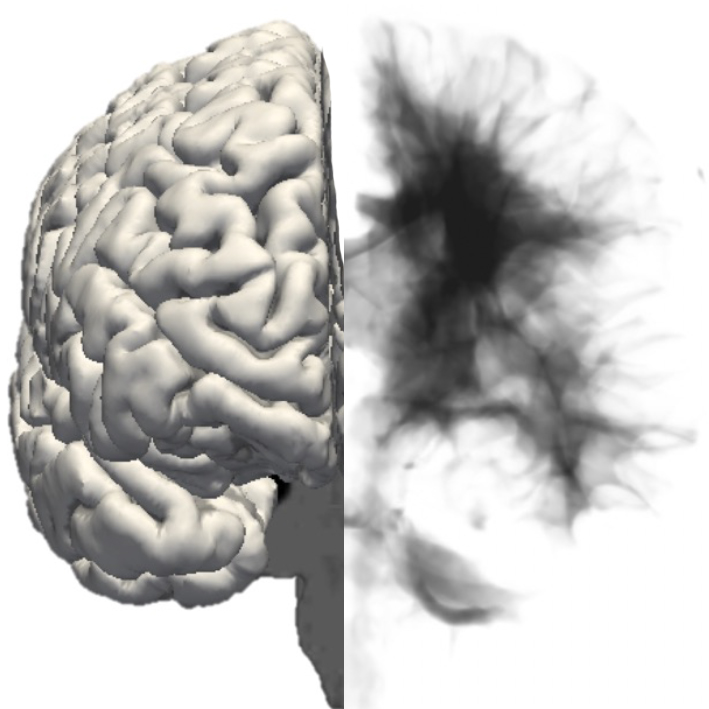
neuremind logo. As is probably obvious, the neuremind logo depicts a brain and mind. These are actually the same image (a brain scan from my research) adjusted for how much detail is shown. This is meant to reflect the trade-off of simplicity and accuracy when communicating science. It is usually much easier to make meaning of something with less detail (as the famous Rorschach tests have shown), but that meaning might no longer accurately represent the original, more detailed thing we are observing or discussing. Grains of salt sections are included for reminders that information on neuremind has been simplified and lost some of its accuracy.
 neuremind