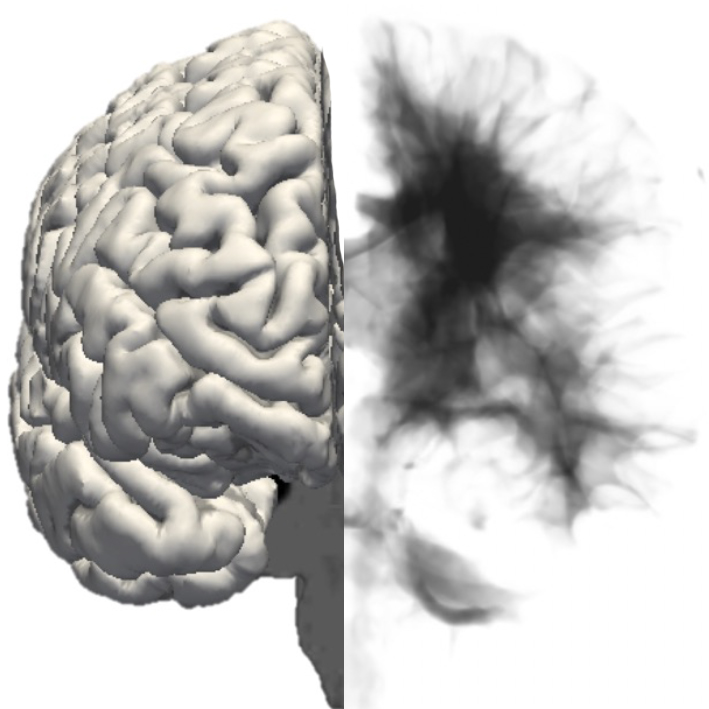
Left vs. Right Brain Personality?

Our brain indeed has two halves (called hemispheres). When one side is different in terms of its activity and functioning it is called ‘hemispheric lateralisation’ (‘lateral’ meaning ‘to the side’). It has become a somewhat popular idea that there are creative and analytical people in the world, different from each other because of a tendency to use their left or right hemisphere more than the other. This myth about lateralisation has two parts:
1.) people will tend to use one half of their brain more than the other (i.e., be a “left or right brain” person).
2.) the left hemisphere of the brain is for analytical tasks, whereas the right right half is for creative tasks, meaning that there are “creative” and “analytical” people.
So, do these beliefs hold up? Let’s see. Firstly, are there ‘left-brained’ and ‘right-brained’ people?
Are there left and right brained people?
Researchers attempted to answer this with a quite famous study (conducted over 10 years ago). In it they looked at scans of brain activity for over 1000 people to see if they could find whether people tended to show overall “more left” activity or “more right” activity. The outcome, no, there was no such being overall left or right-hemisphere dominant.
These researchers did find some differences of activity between each hemisphere. That is, some regions and networks (functionally connected regions) were more active in the left or right. However, what’s important to note is that these differences were not over the total halves (just different parts of each hemisphere are different). This is an example of lateralisation, which is typical for humans and other animals: some certain parts are more active in the left while other parts are more active in the right. Part of my own research is showing that lateralisation might be relevant to how well different people’s brains can process speech (and music). But, that this isn’t a simple case of more left vs more right, but how well the left and right work together.
So, there’s no simple left vs right brain people, the overall activity of both hemispheres is fairly balanced. How about the second belief, is the left hemisphere of the brain for analytical tasks right half for creative tasks?
Is the left brain analytical and right brain creative?
Imagine you have to hire two workers to perform a lot of complex, difficult, and changing tasks. Would you hire two very different workers who can only do very different tasks (i.e., take turns doing nothing whilst the other does everything) or two who can work at the same task in different ways (i.e., co-ordinate to work together for tasks)? Hopefully you chose the second option because that is more how our brains seem to be.
For example, speech is often considered a ‘left-hemisphere’ job. However, both hemispheres can play an important role. Some research shows that the left will be more involved in making sense of meaning of words said (e.g., “Yeah, right” meaning “correct” or the “direction opposite left“), whilst the right will be more involved in meaning of tone of voice (e.g., “Yeah, right” meaning “I understand” or [sarcastically] “that’s not very believable“). This shared ‘division-of-labour‘ makes for more efficient working. The hemispheres have some different ways of working on a task, which means they aren’t creating redundant work by doing the same thing, but also are able to co-ordinate activity (energy spent) according to how much a different way is useful.
So, having our brains as separate creative vs analytical workers doesn’t make much sense. In fact, the separation of creative and analytical doesn’t really either. Take artists/musicians and scientists/mathmeticians (stereotypically opposed creative vs analytical types). Art works and music can very much depend on precision and working in the right order (e.g., paint strokes and colour blending, note timing and order). Mathematics and science can very much depend on ‘big picture’ thinking and inventive insights. Hopefully, both halves of your brain will be involved in any “creative” or “analytical” work you put them to, and that they will be working together (again, in a balanced way).
In summary, our left and right hemispheres do have some differences to them. However, it is not particularly accurate to separate people into being left or right brained overall, or our hemispheres into being more creative or analytical overall, or even creative or analytical themselves as traits. Although there are differences between our hemispheres (for different parts), these differences seem to be about a co-ordinated and balanced way of working with each other.
Is More Brain Better? Do We Only Use 10% and Does Size Count?
Do we only use 10% of our brains?
Brain scanning research has well shown that nothing is going to waste in a healthy brain. Even when we’re not trying to use them – our brains are keeping busy (what’s called “resting state activity”). Despite weighing ~2% of our body mass, our brains consume nearly 20% of our energy. So, depending on how we interpret the myth of “10%”, it would be no good wasting 90% of that energy, or trying to crank that 20% up a further 90% (108% – we’d exceed our body budget… and probably die)!
Our brains aren’t so underused as the myth implies, but they fortunately also aren’t too overused. Although always active overall, each part of our brain will only be active at varying times and in varying amounts. In fact, using “100%” at maximum activity would not only be inefficient but incredibly debilitating. Think of a person being electrocuted on TV – they are paralysed and shaking. Why? Because all their nerves cells are being (over)activated together. Too much activity can be paralysing. A band where everyone is playing as many notes as they can and as loud as they can will turn music into noise. A sporting team all putting maximum effort to be controlling the ball will create mess and exhaustion.
Playing quietly or being silent while a bandmate plays a solo, or resting back in goals while a midfielder takes the ball forward; this is what effective and efficient activity actually is. Thankfully, this is how are brains are wired: for optimal activity through being able to co-ordinate actions (including inaction) in the right amount with the right timing. Essentially, it’s again about balance.
Is bigger better when it comes to brains?
So, more activity isn’t necessarily the solution for a better brain. What about just having more brain? Is bigger better?
If it were the case of bigger is better, humans would have a disadvantage. A number of species are simply larger than humans, with likewise larger brains (e.g., dolphins, whales, elephants) but not likewise signs of more sophisticated mental and behavioural abilities (i.e, “intelligence”). An early rough estimate of brain-intelligence associations was to look at the relative ratio of brain size to body size (brain size:body size). That is, the idea was that animals with a ‘larger-for-their-body’ brain were more intelligent. This approach has not consistently held up in looking at brains and intelligence across various species however. Things have been further complicated by also looking at the ratio of brain cells dedicated to ‘body work’ (e.g., movement, metabolism etc.) relative to those involved in ‘mental work’ (e.g., planning, attention, problem-solving). For example, African elephants have a nearly 3 times larger brain than humans and estimated likewise 3 times number of brain cells. However, humans show roughly 3 times more brain cells in the area of the brain more often associated with mental abilities (the large majority of elephant brain cells being in an area associated with body control). Although this brain size:body size with mental work:physical work approach has some improvements, further criticisms and more complex explanations continued to be put forth by researchers. Currently, we do not have a completely accurate explanation of the relationships of brain size and intelligence, but we can say it’s not as simple as “bigger is better”.
What makes brains bigger?
Brain size is affected by many different things. We look at a brain with our eyes (without a microscope) and just see a brain. But that’s like looking at a city from a plane in the air. There’s much more to it the closer we get. Brains are made up of different areas (which connect together). These are made up of groups of brain cells (which generally organise in a kind of column shape). There are actually many kinds of brain cells, but the ‘typical’ ones most often studied for intelligence are called ‘neurons‘. The size of column groups depends on the amount of ‘neurons’ but also their connecting “wiring”. How many cells there are, how spaced out (tight or loosely) they are, how much wiring is in the space between cells, and other factors can all affect the size. How these columns are organised then affect brain areas, which then affects overall brain size. Again, think about how a city is made up of different areas (blocks etc.), with different buildings, with different people. The amount, spacing, and arrangements of all this (including the stuff that connects them, such as roads) really matters. A feature of human brains that does seem to stand out is the incredible number of neurons (relative to our body size). So why wouldn’t we evolve the just get even more?
The limited real estate of our skulls and how our brains evolved to use that space.
There’s an important limit on brain size: they have to fit in our skulls and our skulls have to fit through a birth canal, as well as stay balanced on top of our body. Take several pieces of paper layered together (most of our brain can be visualised as having this sheet-like structure if flattened out). Hold it up to your head, not a good fit right? Now crumple them together into a ball, an easy fit! You can keep adding more brain in two ways: 1) adding more surface area or 2) more thickness (as long you keep crumpling tight enough). Some parts of a sheet being larger or thicker than others will affect the crumpling. Of course, there is still only so much space to keep adding (no matter how tightly crumpled). If you take a look at human brain images you can see that they look quite wrinkly, which is indeed from a folding pattern. Whilst still not fully understood, a common perspective is that this folding might result from the brain continuing to expand throughout evolution but to different degrees and in different places. Most studies regarding brain size are actually focussed on three aspects: surface area, thickness, and folding.

Having more (or less) surface area, thickness, and folding each seems to contribute to differences of intelligence between humans, but possibly in somewhat different ways for the different aspects. Even more, it seems to depend on the particular brain parts (rather than the whole) and there might be cases of relatively “too much” thickness, surface-area, or folding. Indeed, as above, the brain is already incredibly costly for our body resources, so getting more size is likely going to mean spending more energy maintaining it. Yet again, it’s essentially about balance.
A lesson from our brains: more or less – it’s all about balance.
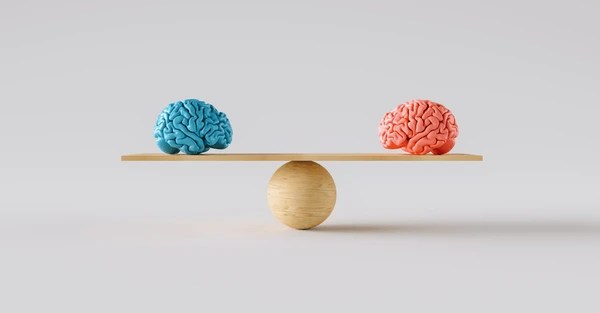
So, we have looked at the left and right hemispheres and how there doesn’t seem to be a simple case of using either side more or less (so we can’t use left-right brain to categorise people). We’ve also looked at brain activity and how although our brains are constantly active, what is most efficient is co-ordinated activity and inactivity between different parts. Finally, we’ve looked at how brain size seems to also need to be looked at in terms of how different parts differ not just in size but in terms of their surface area, thickness, and folding. To bring it all together, lets look at the case of one region involved in speech processing: the ‘planum temporale‘.
The planum temporale is the brain region most commonly found to be asymmetrical (more surface area in the left than right; for most people). It seems to be larger in the left because of a difference layout of neuron column groups. In the left, these groups of neurons seem more spread out and separated from other groups, whereas in the right they seem more tightly packed, overlapping and interconnecting (and communicating) with nearby groups. This layout of the left area is suited to process information more quickly and in a “clear cut” way, whereas the right area layout allows for slower and more “overlap” of signals.
It is very important to emphasise, that neither the left or right planum temporale layout is better or worse, they are just differently suited to different ways of processing information. Again, this allows them to work on the same task in different ways (unless involvement of the other is less needed, in which case they can signal the other to be more inactive). Also important, is that these differences of layout and size aren’t found in all other nearby areas involved in speech. In fact, some areas generally seem larger in the right side (again, for most people). So, it seems that no one size difference fits all.
My own research has shown that having more difference of surface area (which seems to be because of layout differences) between the left and right planum temporale is a factor of why some people show better perception of (some) speech sounds. Other researchers have shown something similar for how differences of activation (i.e., more left than right side activity in the planum temporale) also relates to differences of speech processing abilities (this is interpreted as using inactivity more optimally; whereas the right planum temporale might be more active for other tasks).
Essentially, it seems that having more of something (activity, surface area, thickness, folding etc.) on the left and less on the right, yet more of something else on the right and less of the left is a factor of being better or worse in certain jobs for the brain. Essentially, it’s once more about balance, but not a balance of both being the same but each having differences that complement the other. And crucially, each side co-ordinating with the other to make use of those differences.
A lesson more helpful than the myths: Seek more and less, not just “more”.
These brain myths discussed above (like many others) seem to come back to an idea of “we just need more” (e.g., right-brain creativity, overall brain activity, or more brain itself!). In fact, we should hope to have both more and less. What really seems to count is the ability to utilise differences and be balanced. Inactivity is as important as activity. One layout or approach might suit one task, but be less suited to another. So, what’s truly important, is finding balance through co-ordination of differences, a balance that will change with different situations and tasks at hand.
I don’t think it’s a co-incidence that evidence-based therapies such as mentalization-based treatment (MBT), dialectical behavioural therapy (DBT), and others have this kind of balance of differences as the centre of their treatment. It seems to be the nature of well-working brains, so finding the same with our minds (and relationships) only makes sense.
Grains of Salt
Most questions and research of left and right halves are specifically about the “cortex”, which is the upper and outermost part of our brains. The cortex makes up over 80% of the brain, but the remaining percentage is plenty important, yet often left out of brain research and conversations.
 neuremind